

Biochar research update: January 2026
As part of our commitment to evidence-based innovation, MASH Makes continues to invest in long-term field research to understand how biochar affects crop yields under real-world farming conditions. Our latest trials span multiple crops, regions, and growing seasons, and offer insight into how biochar improves soil health, enhances resilience to climate stress, and supports sustainable agriculture.
Below are the latest updates from three of our key trial sites.
Season 6: Biochar still boosts yields after one application
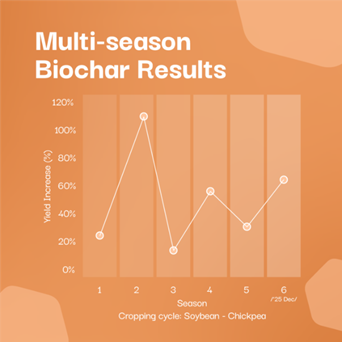
MASH Makes has been conducting a multi-season field trial to assess the long-term impact of a single biochar application on crop yields. Now in its sixth season, the positive results continue: soybean plots treated with biochar produced up to 65% more yield than untreated ones, despite unpredictable weather and no repeat applications.
This trial alternates between soybean and chickpea each season. Even though full plots couldn’t be harvested this year due to weather constraints, yield estimates based on plant samples reinforce the pattern observed over six consecutive cropping cycles: biochar-treated plots consistently outperform controls, with yield increases ranging from 15% to over 100%.
Key takeaways from six seasons:
· A one-time biochar application delivers multi-year benefits.
· Yield gains are evident in both drought-stressed and typical conditions.
· Higher application rates (4 t/acre) show the strongest results.
Season 2 cotton trials: biochar boosts yields under tough conditions
%20(1).jpg)
We’ve wrapped up the second year of cotton trials at MANVLOK, building on the insights from last season. Once again, biochar-amended plots outperformed untreated ones, though the yield difference was less dramatic than what we saw last year.
Here’s what we observed:
· Biochar continues to improve yields: All biochar treatments showed yield increases compared to the control. The highest response (46.3%) came from the4 t/acre application rate. Even at 1 t/acre, yields improved by nearly 33%.
· Seasonal conditions reduced observed biochar effect: In the previous season, biochar plots flowered earlier and reached maturity faster, helping them avoid the worst of the late-season rains. This led to a much larger yield gap compared to the control. This season, rainfall patterns were more uniform, and the absence of drip irrigation and fertigation likely reduced the impact of biochar.
Beed field trials complete, rain skews results
Our scientific multi-season field trials in Beed are designed to observe how biochar performs under real-world farming conditions. The setup included five crops grown in replicated plots with and without biochar.
Nature had other plans. Throughout the cropping period, the site experienced unusually severe and prolonged rainfall, creating unfavourable growing conditions across the board.
Here’s what we observed:
· Extreme rainfall disrupts trial conditions: Excessive rain led to waterlogging and high variability between plots. This made it difficult to isolate any treatment effects, as all crops were affected by the same environmental stress.
· Data collected, but no clear trends: All relevant measurements were taken and analysed, but due to the external conditions, the results do not show any consistent differences between treatments. The impact of biochar, if any, was likely masked.
Even though the findings are inconclusive, the trial still offers value. It highlights the importance of multi-location and multi-season testing, especially in climates with unpredictable weather patterns.
First pot trials: strong plant response to biochar-enriched compost
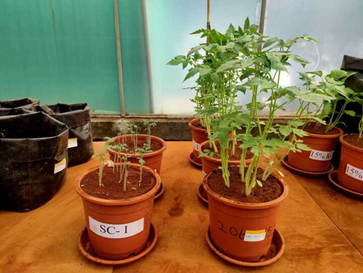
In mid-2025, we began our first-ever pot trials using a compost blend enriched with biochar. Now, the results are in –and they’re promising. Even in a small, controlled setup, the treated crops grew noticeably better than the untreated ones. The blend was applied at a high application rate to make any effects clearly visible.
We saw that among the four crops tested, two stood out. Tomato and brinjal grown in the amended soil were visibly larger and healthier than those in the control pots. The difference was easy to spot with the naked eye.
These were early-stage, small-format trials, but they help build the foundation for broader experimentation. Pot trials area useful way to validate material quality and application methods before scaling up to field conditions.
What’s next?
With more trials planned in 2026, we’ll continue to build on this evidence and explore how different crops respond to different soil treatments. The results so far reinforce what we’ve seen in the field: healthy soils grow healthier crops, and biochar has a clear role to play.
Learn more about MASH Makes biochar at www.mashmakes.com/biochar
More news
Biochar trial shows gains in Season 7
Shipping fuel transition gets real
Biochar Research Update: January 2026
GET INVOLVED
